User-agent: Mediapartners-Google* Disallow: Trucks World News
Google
 
Loading

Oct 26, 2016

TRUCKERS' HEALTH = ROAD SAFETY * Canada

* Ontario - Truckers face tough road for staying healthy


--- That driver barrelling down the highway in a truck weighing up to 63,500 kilograms could suffer from a weight problem that’s making him sleepy... While obesity and drowsiness aren’t concerns only for truckers, people who drive for a living face a particularly tough road — bad food options, a lack of rest stops and long, long shifts spent sitting behind the wheel... A driver opting to pull over somewhere for a nap faces potential safety issues or a ticket, David Bradley, president and CEO of the Canadian Trucking Alliance and Ontario Trucking Association, said ... A multimillion-dollar study is being conducted by the University Health Network in Toronto to research the extent of the sleep apnea problem in Canada, and possible solutions to correct it, he said... The Ontario Ministry of Transportation says commercial drivers must submit a medical report when applying for a licence and additional medical reports every five years under the age of 46, every three years between 46-64 and annually if older than 65 years... The Canadian government plans to mandate electronic log books for bus and truck drivers by late next year to enforce limits on how long they can be behind the wheel and how much time they must rest between shifts...
(Photo by Stan Behal/Toronto Sun - New commercial truckers in Ontario will be required to take entry-level training)   --  Toronto, ONT, CAN - The Toronto Sun, by ANTONELLA ARTUSO - OCT 22, 2016

Labels: , ,

Jun 4, 2016

ROADS SAFETY * USA: Truckers only drive 12 hour and take 10 hours off ???

* Georgia - Trucking safety on the highway

--- The charts show inspections by the motor vehicle carrier compliance unit up by 7000, and violations during those inspections up almost 11,000... Compliance by drivers because they know these officers are watching. The charts break down numbers of crashes by the time of day and location. That way officials know when most officers should be scheduled and on the roads for maximum safety and compliance checks... There is still a big job ahead. Texting and Cell Phone violations by truckers have almost doubled since last May, and speeding violations by big rigs have nearly tripled... The biggest danger everyone agrees is driving too long... Truckers are supposed to only drive for 12 hour stretches and take 10 hours off before hitting the road again... Compliance officers will be checking log books and making sure no driver is forging his hours, which can be a criminal offense... 
 (Picture taken by Trucam of a truck following another 18 wheeler too closely. In this case just 1.3 seconds behind)  --  Savannah, GA, USA - WSAV, by Andrew Davis - June 1, 2016

Labels: ,

May 12, 2016

TRUCKERS' FATIGUE * USA: Give drivers a break

* Is a 73-hour truck driver work week worth the traffic fatalities it would cost?

--- Here's something you don't see every day — trucking companies that want to be more tightly regulated. But that's what happened last week when some of the nation's motor carriers publicly expressed their concern that the federal government is in danger of allowing truck drivers to be on the road too long... Driver fatigue is a leading factor in truck crashes that kill about 4,000 Americans and injure 100,000 more each year. Truck operators need time to rest and recover or else they put themselves and others on the road in danger. While drivers of large trucks are less likely to cause crashes than the average motorist, the consequences of a collision are far more deadly... But some in the trucking industry would like to see the road hour rules relaxed, and they are attempting to change them in the classic back alley method — by attaching a rider to a spending bill. Under an amendment added to the transportation and housing appropriations bill currently pending in the Senate, the nation's 3 million commercial drivers would be able to work for 73 hours in a 7-day period instead of the current 60-hour limit... Those extra 13 hours are no small change — under current rules, truckers can work 70 hours but only if it's spread over eight days, not seven. But don't take our word for it. One of the strongest objections we've seen voiced so far is from The Trucking Alliance, a driver safety advocacy group that is supported by major carriers like J.B. Hunt and Knight Transportation... Does the motoring public want dangerously tired truck drivers on the road? It's a pretty safe assumption they don't, and that's why you seldom see such anti-safety proposals on stand-alone bills — they wouldn't pass if the voters knew what was going on...
Baltimore, ,USA - The Baltimore Sun - 9 May 2016


* North Carolina - Sleepy trucker's crash amplifies dire need for truck parking

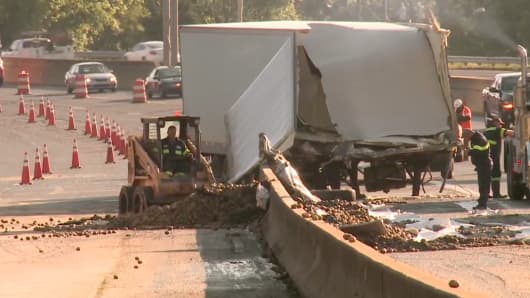
--- When Glen Hamblin’s eyes opened, all he could see was a concrete barrier drawing closer... The 53-year-old truck driver from Hyrum, Utah, had fallen asleep at the wheel after he said he was unable to find a legal place to park while delivering a load of potatoes in North Carolina. Hamblin’s truck, which he purchased less than two months earlier, smashed into the barrier before fuel and thousands of pounds of potatoes spilled onto Interstate 77 about 2 a.m. Friday in Charlotte. The impact of the crash caused the engine to be thrown out of the vehicle, which started on fire... Hamblin was taken to a local hospital with several cuts, but he escaped major injury and was released soon after... Hamblin, who has used electronic logs in the past, said the device adds to the fatigue problem. “E-logs do not work,” Hamblin said. “The company wants you to get your miles in. So when the e-log says you can drive, then you drive. Maybe your body doesn’t say it’s time to drive. With electronic logs, you drive tired” ... Hamblin said this was his first wreck in 11 years. Now he's looking for new employment... 
(Photo CNBC: Truck crashes, dumps potatoes on I-77 North Carolina highway) -- Charlotte, NC, USA - Land Line, by Mark Schremmer - 10 May 2016

Labels: , , ,

Jan 20, 2016

HIGHWAY SAFETY * USA: Improved

* Virginia - Safety within the trucking industry continues to improve


-- That phrase must seem obvious to Transport Topics readers but may appear to be an oxymoron among a public far too used to viewing viral images of the unfortunate aftermath of truck-involved accidents. As we know, the trucker often is immediately blamed, though statistics show that is not the case a majority of the time... That makes the announcement of the latest highway safety statistics all the more important. The total number of people who died in accidents involving large trucks declined 1.54% to 3,903, according to the Federal Motor Carrier Safety Administration. Furthermore, government data show trucks traveled 4 billion additional miles in 2014 than 2013, meaning that the fatality rate fell for a second straight year to 1.4 deaths per 100 million miles, based on an analysis from American Trucking Associations... The data incorporate all trucks weighing at least 10,000 pounds. That is important to note because it means many of the “truck drivers” involved in these accidents do not hold a commercial driver license... We have no way to know for sure, but it is logical someone with the skills required to obtain a CDL is less likely to be in an accident than others. That too, however, is often lost on the public...
(Photo: Weird accident) -- Arlington, VA, USA - Transport Topics - 18 Jan 2016

Labels:

Oct 29, 2015

TRUCKS' SAFETY * USA - Mandatory: Automatic emergency braking systems

* DC - Why trucks are one step closer to automatic brakes


-- NHTSA entertains another incremental step towards transit’s automated future... The National Highway Traffic Safety Administration has now announced that it will consider mandating all large trucks carry the automatic emergency braking systems that could have prevented that accident, and thousands like it across the U.S. each year... Automatic emergency braking (one of various names for the systems) uses radar, lasers, and cameras to see as far as 650 feet in front of a truck—about three times the typical follow distance on highways. They first signal a driver of upcoming obstacles, and then, if the driver doesn’t react, will slow or stop the vehicle. The technology has been available for nearly a decade, and is already in service in tens of thousands of trucks across the U.S. and Europe...


... The bigger picture could give truckers a different set of worries. The past 10 years have seen an explosion of automated systems on trucks, including adaptive cruise control, lane-departure warnings, and electronic stability control (which NHTSA has already mandated for large trucks by 2017). That buildup is leading, bit by bit, to fully autonomous trucks. While that will be a huge boon to overall driving safety, it could also push human truck drivers out of the picture... 
(Photos by Wabco - Wabco’s OnGuardACTIVE emergency automatic braking system for trucks detects vehicles ahead and can apply the brakes to prevent or mitigate damage from a potential crash)    --   Washington, DC, USA - Fortune, by David Z. Morris - OCT 27, 2015


* DC - Heavy-spending trucking industry pushes Congress to relax safety rules for drivers

-- Big rig crashes kill nearly 4,000 Americans each year and injure more than 85,000. Since 2009, fatalities involving large trucks have increased 17 percent. Injuries have gone up 28 percent... Given these numbers, you might expect Congress to be agitating for tighter controls on big rigs. In fact, many members are pushing for the opposite—looser restrictions on the trucking industry and its drivers... The proposals represent a wish list of the trucking industry, including allowing significantly longer and heavier trucks, and younger drivers. The industry spends heavily on lobbying and campaign contributions, giving largely to Republicans, who control both the House and Senate... Supporters insist the proposals actually will improve public safety by cutting the number of trucks on the road while also helping the trucking industry address a shortage of drivers. But critics reject the safety claims as ridiculous, saying the proposals would enrich the trucking industry, not protect the public... Truck safety advocates—many of whom have lost loved ones in big rig crashes—are dismayed over what they describe as the industry’s efforts to use Congress to achieve dangerous policy changes... 
(Photo by Raymond Clarke / Flickr)   --    FairWarning/In These Times, by BRIAN JOSEPH - Oct 28, 2015

Labels: , ,

Sep 30, 2015

DANGEROUS TRUCKS * Australia: Failure to monitor heavy vehicles

* NSW - Victorian failure to monitor dangerous trucks putting NSW drivers at risk


-- The failure of Victorian and Queensland authorities to monitor dangerous heavy vehicles is creating huge risks across the country's roads, exasperated NSW officials say... The triple fatality at Menangle in 2012, when a Lennons truck killed Donald and Patricia Logan and their son Calvyn, and the grounding of the Cootes fleet in 2013, prompted a re-examination of the way in which heavy vehicles are monitored in NSW... In response the number of trucks speeding in NSW has dropped by about 90 per cent, and the defect rate in trucks in NSW has halved... But local authorities are increasingly frustrated by the refusal of interstate jurisdictions to adopt similar methods to those employed in NSW... For instance, the linked Safe-T-Cam system that operates in NSW and South Australia enables Roads and Maritime Services to check vehicle speed, registration, and whether they have been passing through heavy vehicle checking stations. The system also enables them to inspect trucking fleets on a "risk-based" basis, rather than having to rely on random inspections... But because there are no Safe-T-Cams in other eastern states, NSW authorities are unable to monitor the risks of truck drivers and fleets. This means they are unable to get a gauge on whether drivers are taking their mandated breaks... 
(Photo by Peter Rae - Heavy Vehicle Safety Stations at Marulan on the Hume Highway. Photo shows, A truck is checked for faults on the south bound station) -- Sydney, New South Wales, Australia - The Sydney Morning Herald, by Jacob Saulwick - September 28, 2015

Labels: ,

Sep 2, 2015

CRASH TALKING MOBILE PHONE * Australia: Using a mobile phone while driving are more likely to crash than those who don’t

* Queensland  - Introduces new penalties for mobile phone use while driving


-- Double demerit points will be handed out to those caught using their phones while driving... New penalties are now in force in Queensland for people caught using their mobile phone while driving... The Queensland Government says offenders busted more than twice in one year using their phones will receive double demerit points and a $353 fine. Leaner drivers or those on provisional plats will lose their licence... The previous penalty for using a mobile phone while driving was three demerit points... Road safety minister Mark Bailey says the penalties are similar to those currently in place for other serious driving offences... "Drivers caught committing repeat mobile phone offences within a year can expect double demerits, similar to those imposed on repeat offenders who don’t wear a seatbelt or a motorcycle helmet, or who exceed the speed limit by more than 20 km/h," Bailey says,  more than 70 per cent of Queensland motorists have admitted to using or looking at their mobile phone will driving... He says new drivers need to be educated that using their phone while behind the wheel is unacceptable, just like drink driving...
(Photo: Mobile phones best enemies drivers)  --  Brisbane, QLND, Australia- Owner Driver, by Brad Gardner - 1 Sept 2015

Labels: ,

Jul 22, 2015

SAFETY TRUCKS & ROADS ? * USA: A Senate Bill

* DC - That makes roads and railroads less safe

-- Last month the House passed an appropriations bill that would put bigger trucks with overworked drivers behind the wheel on the nation’s highways. If that weren’t irresponsible enough, the Senate is now considering legislation that would allow trucking companies to hire 18-year-old drivers for interstate routes and undermine safety on roads and railroads in numerous other ways... Even by the low standards of the current Congress, these bills are egregious examples of faithfully saying yes to everything industry wants, in this case the transportation companies. The Senate is expected to take up its disingenuously named Comprehensive Transportation and Consumer Protection Act of 2015 this week as part of a larger transportation package that reauthorizes federal agencies and programs. 
 ° One of the measure’s worst provisions would lower the minimum age for interstate truck drivers to 18, from 21, in a misguided attempt to help the industry recruit more drivers. 
 ° Another provision would eviscerate federal rules on how much rest truckers must get. 
 ° The Senate bill would also forbid the department to publish safety ratings of trucking and bus companies, which it currently does on a website. 
 ° The bill would delay an end-of-year deadline for railroads to install positive-train control technology to help prevent accidents like the Amtrak crash in Philadelphia in May that killed eight people and injured more than 200. It would also delay a federal rule that requires trains carrying crude oil to have brakes that can stop all cars at the same time, rather than sequentially. 
 ° The Senate bill also falls well short of addressing important issues raised by recent scandals involving defects in General Motors’ ignition switches and Takata airbags. While it would raise the maximum fine that the National Highway Traffic Safety Administration can levy against automakers that do not promptly disclose defects to $70 million from $35 million, that increase is a pittance for companies that make billions in profits. And by not proposing criminal liability for executives who knowingly hide the life-threatening dangers of their products, the bill simply sidesteps the issue of individual accountability... During hearings about auto defects in recent months, lawmakers from both parties spoke forcefully about safety failures and the need to make driving less dangerous. This legislation does not come close to matching their words. Unless this bill is fixed on the Senate floor, it will lead to more accidents, deaths and injuries on American roads... 
(Photo Credit Tim Lahan)  --  NY, USA - The NYTimes - July 21, 2015

Labels: ,

Mar 11, 2015

SAFETY TRUCKS * USA: The Safety Measurement System (SMS) and Serious Violations spreadsheet

* DC - FMCSA says it has updated SMS

-- The FMCSA uses the SMS to assess carrier safety performance and compliance... A complete list of all Serious Violations and updated descriptions, see the Serious Violations spreadsheet... The list below includes descriptions of the new Serious Violations in SMS and the BASICs to which they relate: 
• — Failing to provide security awareness training, Hazardous Materials (HM) Compliance 
• — Failing to provide in-depth security awareness training, HM Compliance 
• — Knowingly allowing, requiring, permitting, or authorizing an employee with more than one commercial driver's license to operate a commercial motor vehicle, Driver Fitness 
• — Requiring or permitting a property-carrying commercial motor vehicle driver to drive more than 11 hours, Hours-of-Service (HOS) Compliance 
• — Requiring or permitting a property-carrying commercial motor vehicle driver to drive if more than 8 hours have passed since the end of the driver's last off-duty or sleeper-berth period of at least 30 minutes, HOS Compliance... 
(Photo: A Secure Trucking Equipment) - Washington, DC, USA -The Trucker News Services -9 March 2015

Labels: ,

Aug 15, 2013

* Europe - Road Safety

* France - Could Cruise Control Kill You?

(Photo by Flickr user Phil Robinson - Drowsy drivers warning sign) 
Rueil-Malmaison,France -The Car Connection, by Richard Read -Aug 9, 2013: -- For decades, cruise control has been a common feature on automobiles. It's beloved by many road-trippers, who say that it reduces fatigue and boosts fuel economy... But others aren't so sold on the technology... A new study from the VINCI Autoroutes Foundation suggests that cruise control poses other dangers... Researchers identified a number of problems among those using cruise control and speed-limiters: 

- Drivers frequently engaged in unsafe behavior when overtaking other vehicles. 

- When cruise control-users did move back into the slow lane, they tended to do so without leaving a safe distance between their vehicle and the one they'd just passed. 

- Drivers in cruise control scenarios didn't correct their direction as often as other test subjects, meaning that they had a greater chance of slipping into another lane or drifting off the road entirely. 

- Reaction times of those using cruise control were slowed by an average of one second. At a speed of 70 mph, that one second translates to a stopping difference of over 100 feet.

Researchers attribute some of these problems to a lack of attentiveness on the part of cruise control users. Though many proponents of the technology claim that it reduces driver fatigue, the motorist's lack of engagement when using cruise control could cause the opposite to be true...

Labels:

Feb 21, 2013

SAFETY ROADS (?) WITH MARIJUANA ... * USA

* Washington - CNN finds that pot smokers are actually pretty good drivers

(Video from YouTube, by TheNewsthatmatters1: "Drivers stoned on marijuana test their driving skills")
Seattle,WASH,USA -CNN/The Car connection, by Richard Read -20 Feb 2013: -- Back in November, voters in Colorado and Washington States legalized the recreational use of marijuana. And despite federal laws prohibiting pot possession, President Obama has said that arresting users in those two states isn't a top priority... Though several states have legalized medical marijuana, none had established an acceptable THC blood content level for drivers... Washington state set an official threshold of 5 nanograms of THC per milliliter of blood. Though the bill's authors insist that level is based on significant scientific evidence, some claim that it's completely arbitrary. How does 5 nanograms of THC affect drivers? CNN wanted to find out, so the network found an open test course in Washington state and three drivers willing to devote their lungs to an afternoon of "scientific" research. You can judge CNN's findings for yourself by watching the clip above...

Labels:

ROADS SAFETY * USA

* Missouri - Do some homework before considering heavier trucks 

Green Valley,MO,USA -Land Line by David Tanner -19 Feb 2013: -- To those considering truck size and weight increases at the federal and level – please take some time to view the research. Contrary to what supporters of size and weight increases might say, longer and heavier trucks do not reduce the number of trucks on the highways, and they have a negative – not positive – effect on roadway safety and pavement conditions... There’s just no glossing over the science... A congressionally mandated pilot program to increase truck sizes and weights in Maine and Vermont paints a telling picture... “Based on this evaluation, the higher axle weights of these trucks increased estimated pavement damage on the Vermont Interstate System by approximately 12 percent,” the FMCSA wrote in a published report on the pilot program... The yearlong study that began in 2009 allowed heavier truck weights on federally funded highways, including interstates... The Federal Motor Carrier Safety Administration generated reports on the program’s effects on safety, pavement conditions, bridges, energy consumption, commerce and traffic patterns... Rather than increasing truck size and weight in the current highway bill, Congress opted instead to develop another pilot program to provide more data on pavement wear, crashes, the environmental impact and other factors...


* DC - U.S. Traffic Fatalities rise (or not) for first time since 2005

Washington,DC,USA -The Car Connection, by Richard Read -Feb 20, 2013: -- Traffic fatalities have been on the decline for a number of years, thanks in part to safer cars, increased use of safety belts, and a reduction in the number of drunk drivers. But the National Safety Council predicts that fatalities increased in 2012. If so, it would be the first time they've done so since 2005... Every month, NSC receives traffic data from authorities in all 50 states, as well as the District of Columbia. Partnering with the National Center for Health Statistics, NSC tracks not only fatalities, but also injuries, and considers deaths of the injured that occur within one year of an accident to be traffic-related... That's a little different from the National Highway Traffic Safety Administration, the government agency that provides "official" U.S. traffic fatality stats. NHTSA only considers fatalities to be traffic-related if they occur within 30 days of an accident. Also, NHTSA only tracks accidents that take place on public roads, while NSC includes those that occur on private property...

Labels:

Feb 5, 2013

SAFETY ROADS * USA

* Virginia - IIHS: Red-light cameras improve safety, reduce violations

(Traffic cameras cause a lot of controversy. Some folks appreciate the way that the mere presence of a camera can make motorists drive more cautiously. Others see them as a scam foisted on the public by for-profit companies, working in cahoots with local police departments) 
 Arlington,VA,USA -The Car Connection, by Richard Read -Jan 25, 2013: -- The Insurance Institute for Highway Safety (IIHS) has just conducted a new study, which reveals that one type of traffic cam -- the red-light camera -- can significantly reduce the number of drivers who run red lights and, theoretically, the many accidents they cause. Admittedly, the size of the IIHS study was not especially broad: it involved red-light cameras placed at four busy intersections in Arlington, Virgina... It placed two more at non-monitored intersections in Arlington. For control purposes, the IIHS also installed cameras at four intersections in Fairfax County, Virginia, where there are no traffic cams... Here are the study's major findings: 

*  After one year, infractions at the intersections monitored by red-light cameras declined significantly... 
*  At the two sites located along the same travel corridors as the red-light cams, infractions also declined...
*  Curiously, at the sites in Arlington and Fairfax County not being monitored by red-light cams, the number of violations increased...

The IIHS may have the opportunity to test that hypothesis this year: Arlington's 2013 budget contains funds for additional traffic cams...

Labels:

Jan 31, 2013

ROAD SAFETY * Europe

* France - Accidents involving trucks and buses fell 15% in 2012   

Paris,France -Autocar and Bus Infos, 19189 (France), by FG -24 Jan 2013: -- The figures dramatic decline in road deaths in 2012 (- 8% according to preliminary figures from the Road Safety) compared to 2011, good news today fell for trucks and buses. Thus, the number of drivers killed at the wheel of their car or their truck went from 67 in 2011 to 57 in 2012, a decrease of nearly 15%. For the record, the number of truck drivers who died in 2000 was 124. Finally: the number of accidents and injuries (all drivers VL, Vul, PL, cars, bikes ...) fell 6.9%...

Labels:

Jan 25, 2013

SAFETY ROADS * USA

* Michigan - What can Europe teach the U.S. about reducing traffic fatalities ?

(Photo: Car crash at intersection after running red light)
MICH,USA -The Car Connection, by Richard Read -Jan 24, 2013: -- When it comes to traffic fatalities, there's good news and bad news: Good news: the U.S. fatality rate has reached an all-time low... Bad news: according to the National Highway Traffic Safety Administration, that rate isn't going to stay low for long... That's a disturbing possibility, but folks at the University of Michigan Transportation Research Institute suggest that by following the lead of certain European countries, we may be able to reverse course and maintain -- even improve -- America's record-low fatality rates... UMTRI's Michael Sivak, and his colleague, Juha Luoma, suggestions are: 
 - Tougher laws on drunk driving, including lower legal blood alcohol limits and greater use of alcohol ignition interlocks for those convicted of driving while intoxicated. 
 - Lowering speed limits in urban areas, mandating speed-limiters for big rigs and other heavy vehicles, and more deployment of speed cameras. 
 - Making front and rear seatbelts mandatory, and making seatbelt noncompliance a primary offense (meaning that officers can pull over drivers if they spot someone without a seatbelt, rather than needing to cite them for another offense first). 
 - Improving and shortening commutes through better urban planning, more efficient and attractive public transportation, and encouraging businesses to allow their workers to telecommute.

Labels:

Jan 4, 2013

SAFETY * USA


* Canada / US - Safety ratings: Reciprocity cuts both ways

Toronto,ONT,Canada -Truck News, by David Bradley -1 Dec 2012: ... Transport Canada and the US DoT signed a Memorandum of Understanding that each country would be responsible for monitoring a motor carrier’s compliance and safety performance in the carrier’s home jurisdiction... The MOU also obliged both countries to endeavour to establish mutually compatible safety rating and audit programs... Under the agreement, a Canadian carrier who operates throughout Canada and the US would have its safety performance activity (collisions, inspections and convictions) in both countries collected, calculated and monitored by its home province... Under that scenario, a carrier would no longer need both a provincial and an FMCSA profile, or be subject to both provincial and FMCSA compliance reviews. The administrative burden on both government and the industry would be reduced. Safety rating reciprocity was even identified as a deliverable under the Security and Prosperity Partnership initiative... Work continued and in 2008 the FMCSA and CCMTA agreed in principle to reciprocally recognize each other’s safety ratings...


* DC - NHTSA: Data recorders 'essential' to auto safety

(Photo: Black boxes for cars and trucks) 
Washington,DC,USA -The Detroit News, by David Shepardson -19 Dec 2012: -- The Obama administration's top auto safety regulator said automotive black boxes are essential to auto safety and said the government will protect motorists' privacy... In a interview, National Highway Traffic Safety Administrator, David Strickland, said he also opposed on/off switches that could allow motorists to turn off event data recorders, saying it would be a "horrible thing for safety" ... Earlier this month, NHTSA proposed requiring all vehicles built after September 2014 to have event data recorders that capture information before and after a crash... NHTSA estimates that approximately 96 percent of 2013 cars and light-duty vehicles are already equipped with data recorder capability, and at least 91 percent have the devices... A crash or air bag deployment typically triggers the data recorder, which collects data in the seconds before and during impact...


* Canada - Reflect on these handy tips to improve your visibility

(Photo: Convex Mirrors Required on Trucks, Next Best Thing to Truck Back Up Camera) 
Toronto,ONT,Canada -Truck News, by Albert Zimbalatti -20 Dec 2012: -- As important as the view through a windshield may be, the threats beside and behind a truck can hardly be ignored. About one-third of all the collisions reported to Northbridge Insurance involve situations like sideswiping a vehicle or backing into a stationary object... A clear view – whether it is supported by unobstructed side windows or reflections in the West Coast mirrors – can help drivers to defend themselves from these threats... Surprisingly, many mirrors tend to be improperly adjusted, leaving the reflective surfaces filled with a view of a trailer’s side panels rather than helping to spot hazards next to the truck... A properly adjusted fender mirror will display an area from the centre of the steer tire to the middle of the drive axles... A career in trucking offers a moving office with a view. Steps like these give drivers the chance to soak it all in...

Labels: , ,

Dec 4, 2012

ROAD SAFETY * UK & Australia

* Tough new measures to tackle drink drivers 

London,EN,UK -HGV UK -November 26, 2012: -- A package of tough measures to crack down on drink drivers has been unveiled by Road Safety Minister, Stephen Hammond... Included in the proposals are plans to remove the statutory right to a replacement blood or urine test where a breath test reading is above and close to the legal limit, closing the loophole which allows those testing positive in breath to sober up while they wait for a blood or urine sample to be taken... The government also intends to legislate to allow police the option not to perform a preliminary breath test where roadside evidential breath tests are carried out following the rollout of roadside evidential breath testing devices and give registered health care professionals greater roles in testing drink drivers – both of which options would speed up the enforcement process and deal with more drink drivers...


* Australia - Union seeks safeguards, feedback on black boxes

(Photo)
Sydney,NSW,Australia -ATN, by Brad Gardner -November 29, 2012: -- The Transport Workers Union (TWU) will gauge member support for black boxes in trucks, but has already declared the devices must not be used to target drivers... Speaking in the wake of Lindsay Fox announcing his campaign to have black boxes installed in all trucks, TWU National Secretary, Tony Sheldon, says they can potentially play an important part in road safety if used to hold clients accountable... He says the technology should be employed when conducting a safety assessment, with legal restrictions imposed to only allow for the use of black boxes in the event of an emergency...

Labels: ,

Jul 20, 2012

TRUCKS TECHNOLOGY * Australia

* Australia - Forward collision avoidance technology delivers safety results

Adelaide,Queensland,Australia -ATA Friday Facts -20 July 2012: -- The benefits of installing forward collision avoidance technology (FCAT) systems in trucks can be more than nine times the cost, a report by the Adelaide University Centre for Automotive Safety Research shows... The report, "Potential benefits of forward collision avoidance technology", examines 104 crashes around Adelaide that could have been affected by FCAT systems... The report concludes that the benefits of installing FCAT in heavy vehicles are close to $13,700 per vehicle on average. This figure represents the value per vehicle of the reduction in fatalities and injuries delivered by the technology. “The cost of heavy vehicle systems ranges from $1,400 to $5,000. At these prices the benefit cost ratios are easily above unity, ranging from 2.7 to 9.8,” the report says... FCAT systems typically sense other road users or objects in the forward path of a vehicle and perform some combination of actions, which may include priming brake systems, warning the driver, or applying braking...

Labels: ,

Nov 10, 2010

ROAD SAFETY * USA - Trucking Industry Healthier Than Truckers Themselves

The road to fat city


New York,NY,USA -The Daily Feed, by Justin Rohrlich -November 9, 2010: -- While trucking companies like JB Hunt and Knight Transportation are hovering near their 52-week highs, the health of the people driving those trucks is significantly less hale... Federal Motor Carrier Safety Administration chief Anne Ferro, yesterday told a forum in Baltimore that "the life expectancy of a commercial driver is 16 years shorter than the norm," referencing data from the Centers for Disease Control and Prevention... Ferro noted that:

- Only 10% of drivers exercise regularly.
- 54% of drivers smoke tobacco, compared to 21 percent of the general population.
- 50% of drivers are overweight or obese, compared to 33% in the general population.

"We can't sustain figures like that and expect individuals to be healthy contributors to their workplaces and their families, and be safe on the roadway," Ferro said... Something to think about over your next truck stop Frito Pie... (Photo from jimadler)


*  Will  FEDS  regulate FAT truckers ?

Houston,TX,USA -Newsletter Jim Adler and Assoc, by Hugo Aguilar - (originally published on) Jun 23, 2010: -- By now, we all know it’s not healthy to be overweight. Medical reports rail against excess body fat, citing statistics that show even a few extra pounds can cause serious illnesses, from diabetes to heart ailments. Americans trying to stay healthy fight battles with their bathroom scales every day all over the United States...   But what about other people’s fat? Can it kill us too? Yes, according to sleep scientists at Harvard University. Their studies of the link between being overweight and sleep apnea have the Federal Motor Carrier Safety Administration considering new rules to require screening of overweight truck drivers. Harvard scientists estimate that 28 percent of commercial truck drivers on U.S. highways suffer from mild or severe sleep apnea. The disorder shuts off airways, causing them to wake up dozens, even hundreds of times every night, leaving them generally fatigued and often, grievously sleep deprived. People with sleep apnea have a tendency to nod off during normal activities. A few seconds asleep at the wheel of an 80,000 pound truck rolling down the highway could easily be fatal to nearby drivers...  While the federal government is looking seriously at new rules to curb sleep apnea in overweight truckers, it has no deadline for implementing them. Supporters say the rules could help prevent the truck accidents that kill more than 5,200 people a year and injure another 100,000. Critics say the rules could idle up to 40 percent of the truckers on American roads. Meanwhile, successful treatments for sleep apnea include a device that supplies oxygen during the night and keeps airways open, leaving truckers with sleep apnea rested and ready to go...

Labels: , ,

Jul 10, 2010

ROAD SAFETY * UK - FTA says new road mirrors will cut HGV cyclist deaths

London,UK -Road Transport, by Chris Tindall -8 July 2010: -- The Freight Transport Association says it is convinced that the use of 'Trixi' safety mirrors at road junctions in London will improve cyclists' safety when they ride alongside HGVs... Transport for London (TfL) and mayor Boris Johnson unveiled the first mirror in Tooting last week, and 37 more are due to be installed across the capital's cycle superhighway routes for a six-month trial... TfL says they give lorry drivers better visibility of cyclists at junctions and should reduce the number of cyclists killed or seriously injured in collisions with HGVs... The trial coincides with a poster campaign highlighting the potential dangers cyclists put themselves in when they ride up the left hand side of HGVs at junctions... (Photo from farm3.static.flickr)


* UK - Time to watch the weight


London,uk -Road Transport, by Guy Sheppard -7 July 2010: -- With fines of up to £5,000 for each offence, there should be sufficient incentive for drivers and operators to comply with overloading regulations. Yet since VOSA (Vehicle and Operator Services Agency) began issuing graduated fixed penalties in May last year, excess weight has been the most common offence, along with faulty brakes... And research published last month by the Department for Transport (DfT) found that 7% of 44-tonners were recorded as being overloaded by weigh-in-motion equipment... Drivers and operators are both liable to prosecution if a vehicle is overloaded on gross weight or axle weight. One cause for confusion is that the design weight of each vehicle and its axles, shown on the manufacturer's plate, sometimes differs from the legal maximum for these, shown by the DfT or 'Ministry' plate... Fixed penalties issued by police and VOSA are set at £60 for overloads of less than 10%, £120 for overloads of between 10% and 15% and £200 for overloads of at least 15%... Sentencing guidelines for magistrates state that in cases where the overload is no more than 10%, fines should range between 25% and 75% of "relevant weekly income" for drivers and between 125% and 175% for owner companies... The guidelines also state that the fine should be increased by 10% for every 1% increase above a 10% overload...

Labels: