![[Valid Atom 1.0]](valid-atom.png "Validate my Atom 1.0 feed")
TRUCKS vs. TRAINS * USA - Railroads boast fuel advantage
Trucks struggle as diesel costs rise


Labels: trucks vs trains
posted by Unknown @ 8:00 AM
0 comments


News about: Trucks - Truckmakers - Truckers and the Trucking Industry

Labels: trucks vs trains
posted by Unknown @ 8:00 AM
0 comments
Labels: trucks vs trains
posted by Unknown @ 12:16 PM
0 comments
 Sydney,NSW,Australia -ATN, by Brad Gardner -January 11, 2010: -- The New South Wales Government has refused to reinstate a rail fuel subsidy despite Opposition claims it will improve road safety by taking trucks off the road... A spokesman for Transport Minister, David Campbell, says there are no plans to restore the 1.2 cent per litre Fuel by Rail Scheme for petrol companies axed in November 2008... The Opposition called for the scheme to be reintroduced after fatal incidents involving petrol tankers in NSW during the Christmas holiday period... Coalition leader Barry O’Farrell says the subsidy will cut the need for truck movements, and a spokesman for O’Farrell says the Opposition will keep fighting to have the subsidy re-introduced... Australasian Railway Association CEO Bryan Nye has backed the Opposition’s move, while the Rail, Tram and Bus Union wants petrol, diesel and gas shifted to rail...
Labels: trucks vs trains
posted by Unknown @ 8:25 AM
0 comments
Congress could give tax break for freight rail expansion - Trucks use three times more energy than trains-experts
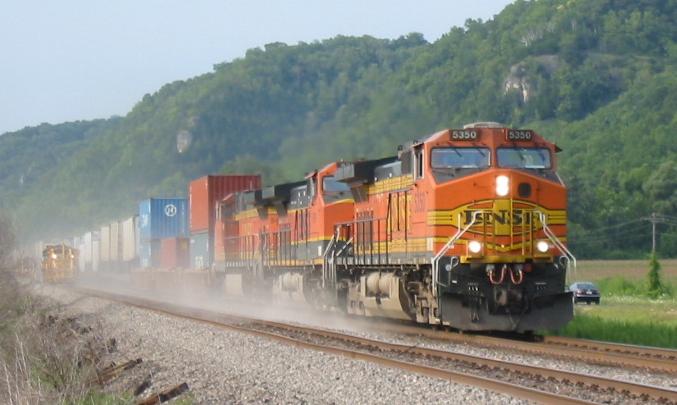
 New York,NY,USA -Reuters, by Basil Katz/Alan Elsner & Michelle Nichols -Nov 11, 2009: -- U.S. truck operators are under pressure to improve energy efficiency as rail companies tout their green credentials and bid to win more freight haulage... The American Trucking Association says trucks transport about 70 percent, or 10 billion tons of all U.S. freight annually. But they use at least three times as much energy as trains per ton carried, analysts say... The recession cut the amount of freight hauled around the country more than 10 percent compared to last year, says the American Trucking Association. But that was a temporary blip... The 2.2 million registered semi-trucks, which account for most U.S. heavy long-haul transportation, averaged 5.1 miles per gallon (8.2 km per 3.8 litres) in 2007, said the Center for Transportation Analysis at Oakbridge National Laboratory... Rail companies, which would like to become a green alternative to trucking as the economic recovery gathers steam, were boosted when Warren Buffett's Berkshire Hathaway recently agreed to spend $26 billion to buy railroad operator Burlington Northern Santa Fe Corp ... The Rocky Mountain Institute says the fragmented trucking industry makes achieving progress complicated... In a recent study, it highlighted common ways that truckers waste energy, from returning empty after deliveries to keeping the engine running all night while parked to stay warm... (Photo from wikipedia: BNSF on Prairie du Chien,WI)
Labels: trucks vs trains
posted by Unknown @ 7:53 PM
1 comments
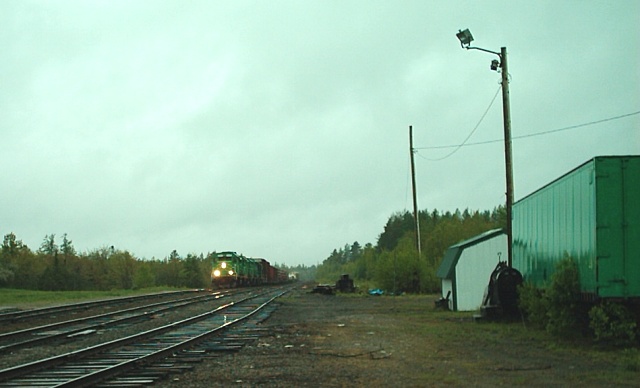
 New York,NY,USA -Transport Topics, by John Burton -19 Oct 2009: a -- You can’t watch television these days without hearing some railroad companydvertising the “green” benefits of moving freight from the road to rail. The most often heard is the claim by one major railroad that “one ton of freight can be moved 436 miles on one gallon of fuel.” Another large railroad boasts a 470-mile claim in its 2008 Annual Report... At first glance, these numbers seem to indicate there is no way trucking can compete and intermodal has to be the future for our efforts to go green. However, it is important that we dig deeper and look at “environmentally friendly” from a broader perspective... Besides, intermodal still requires trucks... Drayage is usually required at both ends of the journey, adding truck miles to get the freight to market. For example, a truckload from Columbus, Ind., to Reno, Nev., will travel about 2,100 miles over the road. However, an intermodal move likely will travel 240 miles on the road to Chicago, 2,415 miles on rails to Stockton, Calif., and 155 miles on the road back to Reno — a 34% increase to 2,810 total miles... Using the railroad’s own carbon calculation methodology, trucks produce 270% more carbon output. But using our real-world example, the carbon differential for the total move is only about 65% higher... However, this still isn’t the whole story... (Photo from traingeek.ca: Vanceboro Maine)
Labels: trucks vs trains
posted by Unknown @ 10:47 AM
0 comments
 Washington,DC,USA -DC Streeets Blog, by Elana Schor -October 13, 2009: -- Interstate 81 stretches for 846 miles through six states -- New York, Pennsylvania, Maryland, Virginia, West Virginia, and Tennessee -- and serves as a crucial corridor for freight traffic. But crucial doesn't mean safe or enjoyable, and I-81 is an undisputed hotbed of traffic accidents... As the Washington Post reported in July, one out of every four vehicles on I-81 is a truck, a higher rate than the road was designd for. Between 2003 and 2007, the Post found, I-81's accident fatality rate was nearly twice the size of the much larger I-95, which experienced more crashes overall... So what can be done to keep freight cargo moving while making I-81 safer and more efficient? Unfortunately, environmental groups and local residents have spent much of their time fighting off plans to widen the highway, including an $11.4 billion effort to double the number of lanes for nearly half the length of the road... Virginia Transportation Secretary, Pierce Homer, told the gathering that the six states along I-81, in adition to several southern neighbors, are seeking $300 million in economic stimulus aid to pay for expansion of freight rail... (Photo by WaPo - The safety and freight challenge that is I-81)
Labels: trucks vs trains
posted by Unknown @ 10:53 AM
0 comments
State Truck Numbers Reaching Critical Mass
 Melbourne,VIC,Australia -Handy Shipping Guide –6 October 2009: -- Voices have been raised in the State of Victoria lately as residents wait anxiously for some sign that truck numbers transiting to and from the coast are reducing... The Governments original target, now supposedly abandoned, of 30% of all cargo to be carried by rail seems unrealistic. At the moment it is estimated that the figure is closer to 2%. The inception of the incredibly extensive Victoria Transport Plan is seen by many locals as long on promises but short on achievements... Shadow Transport Minister, Terry Mulder, has this week obtained his heavy rigid truck licence and admits it has opened his eyes to both sides of the problem. Unless action is taken forthwith however the chilling Government predictions for truck movements, from the present 600,000 or so today to over 1,100,000 by 2030 may cause social problems on an unprecedented scale...
 Labels: trucks vs trains
posted by Unknown @ 9:18 AM
0 comments
It is one of the defining images of the rural US
Labels: trucks vs trains
posted by Unknown @ 7:22 AM
0 comments
Spiking diesel fuel prices have deflated trucking stocks and made road kill out of many a small motor carrier
 Indianapolis,IN,USA -Indianapolis Business Journal -June 7, 2008: -- ... The rising price of diesel is poised to invigorate a mode of transportation that trucks nearly annihilated—the 40 freight railroads crisscrossing the state... The diesel-fueled locomotives that run on them have one giant advantage over the ordinary Freightliner or Kenworth: They’re commercial transportation’s version of the Toyota Prius hybrid... By coupling diesel engines to electric generators that power steel wheels, your run-of-the-mill diesel-electric locomotive is at least three times more fuel-efficient than a semi. One gallon of diesel can move a ton of freight an average of 436 miles, the Association of American Railroads is fond of touting... The trend clearly favors railroads if diesel prices remain high; they recently averaged $4.70 a gallon. That’s nearly $2 more per gallon than this time last year, or $570 more to fill a semi’s twin 150-gallon tanks. Trucking firms inevitably pass on all or part of that to their customers...
Labels: trucks vs trains
posted by Unknown @ 4:20 PM
0 comments