User-agent: Mediapartners-Google* Disallow: Trucks World News
Google
 
Loading

Oct 15, 2016

UBER's news * USA: Unemployment payments to two former drivers

* New York - Uber drivers ruled eligible for jobless payments in 

--- Two former drivers for Uber are eligible for unemployment payments, New York State regulators have ruled, finding that they should be treated as employees rather than independent contractors, as the company has maintained... Unlike contractors, employees are entitled to a variety of rights and protections, including a minimum wage and workers’ compensation insurance, and are typically more costly for companies to rely on... The decision could make it more difficult for Uber, its rival Lyft and other new businesses operating in what is known as the gig economy by raising their costs and challenging their business model...
(Photo by Kevin Hagen/The New York Times - Uber drivers in a staged strike in Long Island City, Queens, in February)   --  NY, USA - The NYT, by NOAM SCHEIBER - Oct. 12, 2016

Labels: ,

Feb 3, 2016

* PROGNOSIS: AUTOMATED DELIVERY TRUCKS SYSTEM * Switzerland

* Swiss considering $3.4 billion cargo tunnel for

(Video from AMBERG LOGLAY AG - Jan 27, 2016: Underground logistics infrastructure system. Here's how it's all supposed to come together)

-- In the parts of the world where it seems that just about everyone has a car, we all want to get away from the crush of traffic. But after a certain point, traffic problems can’t be solved by building more roads. They’ll just generate more traffic, unless you do irritating things like charging money to use them. Switzerland, where the volume of road traffic directly related to the transport of goods is expected to increase by 45 percent over the next 15 years, lacks the infrastructure to handle that growth. So it’s in need of a creative solution, and fast... One alternative is building an expensive transit option like rail lines. But Switzerland is considering a novel (and even more expensive) solution: a $3.4 billion underground cargo tube full of automated delivery carts... Last week, Cargo Sous Terrain presented a feasibility study in Zurich detailing its plan for, uh, cargo sous terrain (underground cargo). The idea is to dig a 66.7-kilometer-long, 6-meter-wide tunnel 50 meters below ground. The thoroughfare would connect Zurich with logistics centers out to the west, south of Bern. The pilot tunnel would connect to four above-ground waystations that link the tunnel to cargo transfer points. The eventual goal is to expand the dedicated cargo network so that it connects Zurich with Lucerne and eventually Geneva... The tunnel itself would contain three lanes for autonomous, inductively powered electric delivery truck-things as in the rendering above. The trucks would zip along at 30 kilometers per hour; above them, there would be a separate monorail system whisking smaller packages from Point A to Point B at 60 km/h. Power to run the underground parcel hauling system is supposed to come from renewables, including the energy collected by solar panels mounted on the roofs of the transfer stations... Part of the idea here is that you could replace big trucks with smaller vehicles that deliver things more frequently in urban areas (vans, cars, scooters, or eventually even small ground robots or delivery drones). Rather than getting one big delivery at the beginning of the day, businesses could depend on a constant trickle of goods, which would be more flexible. And you'd never see big trucks in urban areas at all, since they'd spend their time moving goods directly to the cargo transfer stations as opposed to businesses themselves... The entire project will depend on private financing; but who’ll put up the money remains an unanswered question. $3.4 billion is, after all, kind of a lot of money. It's not too difficult to imagine that using the tunnel would save distributors enough time and money that it could pay for itself over time with delivery fees. But who’ll be willing to make such an enormous up-front investment on an unproven idea? This isn't the first time we've heard of schemes for underground cargo transport; none of the rest of them have panned out... Even if funding were secured, the earliest we could expect to see the tunnel operational is 2030... 
Zurich, Switzerland - IEEE Spectrum, by Evan Ackerman - 1 Feb 2016

Labels: , ,

Dec 5, 2015

MILLIONS TRUCKS OFF ROADS * India: From April 1st.

* Delhi - 2.7 mn trucks to go off road from 1 April as govt proposes a ban

-- The order would be made public within 10 days and the ban on trucks that are older than 15 years will be enforced from 1 April... As many as 2.7 million trucks are expected to be taken off the road from 1 April when the government enforces a ban on trucks that are older than 15 years, according to vehicle registration data available with the roads ministry... The step will create an immediate spike in demand for commercial vehicles as sales start to look up after a prolonged slowdown. During the April-October period, sales of commercial vehicles grew 8% to 373,000 units, while overall automobile sales grew 2.46% to 12.05 million units... Environmentalists believe the move will also help reduce emission levels. As much as 30% of the total particulate pollution from the transport sector comes from trucks... A spokesperson for the Society of Indian Automobile Manufacturers (Siam) declined to comment, requesting time until a government notification is made public... A number of studies in the past few months have labelled Delhi as the world’s most-polluted city. A dozen other Indian cities figure among the 20 most polluted cities across the world... Over the past few days, smog has covered the city-state as farmers in neighbouring Punjab and Haryana torch crop waste, flouting a ban... 
(Photo: Ramesh Pathania/Mint - The ban will create an immediate spike in demand for commercial vehicles as sales start to look up after a prolonged slowdown)  --  New Delhi, India - Live MINT, by Amrit Raj -

Labels: ,

Apr 22, 2010

TRUCKING INTELLIGENCE * USA - Keeping Trucks Full, Coming and Going

It's an age-old problem: How to find cargo for their return trip home after they’ve made their initial delivery

Lawrenceville, N.J.,USA -The New York Times, by KEN BELSON -April 21, 2010: ... Yet more than a quarter of the trucks on the road in the United States drive empty, according to industry estimates... Some of the country’s largest retailers, manufacturers and trucking companies are working on a solution, sharing information about their trucking routes in hopes of matching empty trucks with goods that need to be shipped... Known as Empty Miles, the program is the brainchild of the Voluntary Interindustry Commerce Solutions Association, or VICS, a nonprofit group that tries to make the supply chain in consumer goods industries more efficient... For decades, companies have tried to eliminate empty truck miles in an ad hoc fashion. One company would hear about another company that shipped along the same route. One manager would call his counterpart and work out a deal. Then, about two years ago, VICS members representing a swath of corporate America bore down on the problem. Diesel fuel was near record highs; the economy was slowing. Running empty trucks was more and more the difference between profits and losses; running fewer trucks was a way to reduce emissions and help meet corporate sustainability goals... VICS worked with GS1 US, the standards group that developed the bar code, to create a portal where shippers including Macy’s, J. C. Penney and Levi Strauss, and two dozen trucking companies can list their empty truck routes... While there are many shippers along the Eastern Seaboard and to the Midwest, it is harder to find matches on longer routes in the Western United States... (Photo: A Macy’s operations center in Secaucus, N.J., which serves the Northeast. Macy’s says that through the Empty Miles program it has found other shippers for 30 of its empty truck routes)

Labels:

Oct 14, 2009

INTELLIGENCE in TRANSPORT * USA & Canada - Rail system no Mickey Mouse project

WHY SHOULD YOU CARE

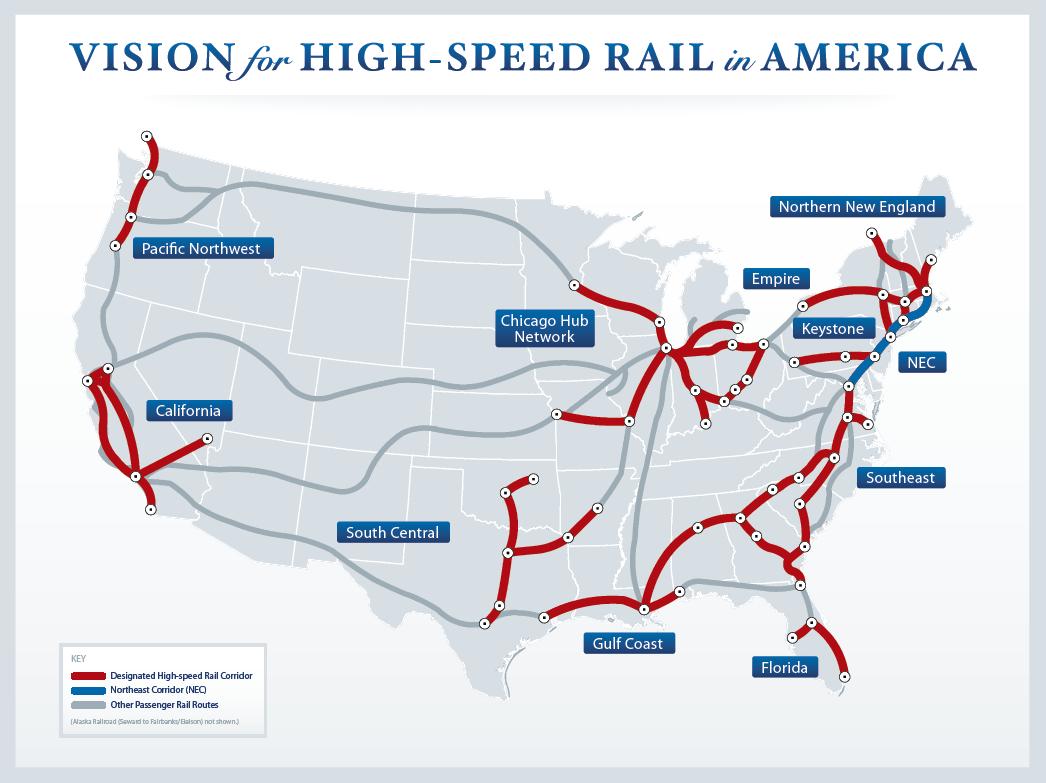
Miami,FL,USA -Daily Commercial -October 11, 2009: -- In a move that may finally push even the stubborn Florida state legislature to hop on board, Disney announced last week that it has decided to join the state of Florida in reaching for $2.5 billion in federal aid to build a 90-mile, high-speed rail project linking Orlando and Tampa... Because the advantages to such a system far outweigh the disadvantages... The fuel savings alone for rail versus trucking are astronomical... Tracks don't retain water or require drainage. They don't need extensive rights-of-way purchases in order to be built... Building the required infrastructure would create thousands of new, permanent, skilled jobs at a time when they've never been more sorely needed...

HISTORY: The monumental project linking America's East and West coasts in the 1870's would not have been possible without guaranteed government contracts to carry the mail. Between that time and the 1930's, America moved by rail... But after World War II, the nation moved away from rail transport with the development of the interstate highway system.
President Eisenhower had been mightily impressed with the German autobahn's ability to move troops quickly across the country during the war, and was determined to bring such a system to the United States. The trucking industry, therefore, was the immediate beneficiary of advance military planning. The interstate system indirectly subsidizes truckers by first building, then maintaining the transportation grid. Imagine, if you will, the transportation costs involved if truckers had to pay the true costs of moving the nations' products to market. And as the trucking industry sucked the life out of the railroads' freight business, so did the emerging airline industry cut deeply into rail's passenger base... As profits fell, rail systems fell into disrepair and the companies that owned them struggled against bankruptcy...

WHAT HAPPENS NEXT?: The construction lobbies in Washington continue to fight hard for the trucking interests, but no one, especially here in Florida, has emerged to take up the cause of rail.
Gov. Crist and a few legislators mouth support, but none has become a true champion of what is undoubtedly a wave of the future... They seem not to understand that surface transportation has reached a point of diminishing returns. We can't keep adding lanes to existing highways without running out of room, and construction costs are skyrocketing as the price of critical ingredients - cement, for example - goes through the roof. And all this is happening at precisely the same time that frustrated commuters want a faster, more humane way to travel - one that doesn't involve being stranded for hours in never-ending traffic jams... High-speed rail also is opposed by the trial lawyers' lobby because owners of the track upon which the feeder lines would run want to keep riders from suing the railroads in cases of serious accident. Why, they wonder, should track built to handle freight cars traveling at 25 mph be forced to absorb damages sustained by passenger trains traveling at three times that speed?... It's a serious question that needs to be addressed, but a mere legal disputation shouldn't deprive Floridians of a transportation system built to accommodate the future, rather than one doomed to wallow in the mistakes of the past... Let's move forward with high-speed rail now... (Image from wikipedia: High Speed Rail)


ANOTHER OPINION

* Response To Transportation (Trucking) Industry Publication Communicating Gary Locke’s (Obama’s Secretary of Commerce) Downplaying of “Climate Change”

Eugene,OR,USA -Peoples Equity Union -October 12, 2009: -- I tend to believe that the greenhouse effect and global/warming climate change is real. We have had evidence for more than 40 years and the overwhelming geophysical evidence presented by scientists almost seems to be at consensus these days ... There will always be a need for long-range transport, as few if any regions could realize total self-sufficiency and comparative advantages do exist. However, the transportation industry can do their part for the youth and children, the survival of the species, by considering their role and the adjustments that will need to be made (in shifting to a more regional and inter-community/within regions economy)... Please consider the policies, programs, strategies, and actions that you can take to cooperate...


* Canada - North American railways and truckers face near-term pressure ahead of recovery


Montreal,QBC,CAN -The Canadian Press/The Telegraph Journal, by Ross Marowits -October 14, 2009: -- North American railways and truckers continue to feel the negative effects of the economic recession ahead of a recovery that isn't expected to be in place until 2011, industry analysts say... Significant drops in carload and freight volumes should result in lower revenues and earnings when the companies report their quarterly results starting next week...
(Photo: A Canadian National Railway Co. freight train passes over the Salmon River rail trestle near New Denmark. CN will continue to face near-term pressure because of the slow pace of the economic recovery, analysts say)

Labels:

Jun 30, 2009

TRANSPORT INTELLIGENCE * USA - New York/New Jersey port launches second shipper incentive program

New York,USA -Progressive Railroading -29 June 2009: -- Last week, the Port Authority of New York and New Jersey’s (PANYNJ) board of commissioners approved an incentive program aimed at encouraging shippers to transport cargo via new rail routes — the authority’s second intermodal incentive program of the year... PANYNJ will provide $25 per container to any company booking cargo on a railroad to or from a new ExpressRail origin or destination that was launched after Jan. 1. For example, Norfolk Southern Railway recently began offering service from the Port of New York and New Jersey to Harrisburg, Pa., a move traditionally handled by trucks, the authority said... In January, PANYNJ began offering shippers a $25-per-container incentive for each container transported by rail above the total volume they registered the previous year... (Photo by farm4.static.flickr: GWB Administrative Building, The Port Authority of New York & New Jersey)

Labels:

Jun 26, 2009

Transport Intelligence * USA - Dredging the Sacramento Deep Water Ship Channel

Sacramento,CAL,USA -News Review, By Jeff vonKaenel -25 June 2009: ... It takes roughly 1,000 diesel trucks to unload and transport cargo from a ship docked in Stockton or San Francisco to Sacramento. After the dredging is completed, the Port of West Sacramento will be able to handle an additional 157 ships per year, potentially avoiding 157,000 truck trips. In addition to not clogging up our highways, a single large ship emits significantly less air pollution than 1,000 trucks. If the Obama administration follows through with plans to restrict the use of low-sulfur fuel oil while ships are traveling inland, ships will burn even cleaner... Port of West Sacramento manager, Mike Luken, says they’ve already contracted for another 118 ships to use the port. The dredging project appears to be going full steam ahead ... (Aerial Photo www.aerialarchives.com/stock/img/AHLB2300.jpg: Sacramento river deep water ship channel, levees. Prospect slough, Sacramento San Joaquin river delta)

Labels:

Apr 22, 2009

TRANSPORT INTELLIGENCE * USA - Changes at three Maine ports could be a boon for cargo and business

It's a dynamic time for Maine's major cargo ports

Maine,USA -Mainebiz, by Mindy Favreau -20 April 2009: -- While a resurgence of pulp shipments has led to the return of container service at Portland's International Marine Terminal, the idling of another pulp mill has forced its Down East counterpart, the Port of Eastport, to diversify. And despite economic conditions and environmental backlash, the state is moving forward with plans to develop a new cargo port on Sears Island, which could be a boon for the state's paper industry... Instability in the state’s pulp and paper industry, a main driver of shipping activity in Maine, has forced the ports to seek new sources of activity and new ways to operate in order to ride out the market’s pitching and rolling. All three major cargo ports — Portland, Eastport and Searsport — have handled or are gearing up to handle shipments of wind turbine components destined for wind farms in northern New England and Canada. This growing industry has helped sustain the cargo ports during slow times and could supplement port activity for years to come, says John Henshaw, executive director of the Maine Port Authority. “If the state develops an expertise in handling this cargo, then it’ll be in a competitive position when offshore wind is developed,” he says...

Labels:

Jul 30, 2008

INTELLIGENCE in TRANSPORT * Switzerland - Collapse of WTO talks threatens global trade

Geneva,Switzerland -Transport Intelligence, by Rob Walter -30 July 2008: -- World Trade Organisation (WTO) director-general Pascal Lamy has announced that after days of negotiations, ministers have failed to agree on the liberalisation of trade in agriculture and industrial products. That has led to the collapse of the whole trade negotiation process which, if successful, would have resulted in a major boost for economies in the developing and developed world... Talks foundered on agreeing a 'special safeguard mechanism' in farm products for developing countries and ultimately came down to an impasse between the US and India. Lamy's summary of the situation was bleak. "It is no use beating around the bush. This meeting has collapsed. Members have not been able to bridge their differences," he told journalists later... Out of a 'to-do list' of 20 topics, 18 had seen positions converge but the gaps could not be narrowed on the 19th — the special safeguard mechanism for developing countries, which would have allowed those countries to raise tariffs temporarily in order to deal with import surges and price falls...

Labels:

Apr 25, 2008

Transport Plan * Russian - Government preliminarily OKs 2010-2015 one

Moscow,Russia -Prime/Tass -April 24, 2008: -- The Russian government has preliminarily approved the federal special-purpose program to develop the country's transportation network in 2010-2015... The current program has a shortage of funds for the construction of roads and railroads, Transportation Minister Igor Levitin said. The shortage of funds for the construction of railroads will be covered either by revenue from higher tariffs for rail cargo transportation or by additional funds from the federal budget, Levitin said. The shortage of funds for the construction of roads will be covered by charging trucks with a weight of over 12 tonnes for using federal roads and by private investment, Levitin said... The program envisages the construction and reconstruction of 7,300 kilometers of federal roads and 116 runways... The implementation of the program will also help increase cargo transit across Russia to 42.7 million tonnes in 2015 from 28 million tonnes in 2007, Russian Prime Minister Viktor Zubkov said... (23.3448 rubles - U.S. $1)

Labels:

Nov 2, 2007

TRANSPORT INTELLIGENCE * China - Survey: Cold chain modernisation needs foreign help

Australia -Supply Chain Review -October 29, 2007: -- Australian companies with the expertise and resources needed to fill the gaps in China’s inadequate cold chain logistics stand to benefit from a projected USD$160 billion in annual cost savings that a modernised system could deliver... That's according to a new study by A.T. KearneyChina’s Cold Chain Challenges which reveals the country’s broken food safety process will be overwhelmingly insufficient in meeting the expected US$650 billion (US$150 billion in 2007) in food spending by China’s middle-class in 2017... It also shows that ignoring China’s problematic cold chain logistics poses a significant risk to food manufacturers, with consumers ready to dump brands involved in food safety incidents...

Labels:

Sep 2, 2007

TRANSPORT INTELLIGENCE * USA - Global Airfreight Begins, Ends in U.S. Heartland, Thanks to Trucking

Industry observers say the improvements in trucking services that are pulling shipments from domestic air market are raising new possibilities for international trade.

Roswell,GA,USA -Air Cargo World -August 29, 2007: -- ... It means once-specialized road feeder services are offering expedited trucking from both coasts as well as between the United States and Canada and Mexico, providing links to broader global supply chains. For airports, airlines and forwarders looking for new business, that means the search increasingly begins on the road. It's one reason, experts say, a growing number of Asian and European airlines are flying freighters past the traditional gateways on the Pacific and Atlantic coasts, landing instead at such cities as Atlanta, Dallas, Houston, Chicago and Nashville, Tenn., where efficient trucking services increasingly are connecting to a wide swath of markets for both imports and exports...

Labels:

Aug 4, 2007

TRANSPORT INTELLIGENCE * South Africa

* India - Tatas, M&M plan more rollouts in SA
Mumbai,India -The Business Standard (India), by Swaraj Baggonkar -August 4, 2007: -- Two of India’s leading auto companies, Tata Motors and Mahindra and Mahindra (M&M) are ramping up their presence in South Africa with new launches, as well as setting up assembly line-ups there... Ravi Kant, managing director, Tata Motors, said, “The market in South Africa is very good and is growing at a consistent pace. We also want to grow in that country and are planning to use the recently acquired Nissan plant as a manufacturing facility for trucks, or cars, or both. Production could start in 12-18 months”... The automobile market in South Africa grew by 15.7 per cent in 2006, with 7,14,340 cars, utility and commercial vehicles sold. Comparably, the Indian auto market grew by 23.66 per cent in 2006-07, during which period 1,847,580 units (excluding two- and three-wheelers) were sold... M&M, India’s leading utility and tractor manufacturer, has also decided to launch its high-end tractors, followed by trucks and trailers, in SA within the next few weeks... Official launch dates for trucks and trailers is yet to be decided. Tractors will be introduced within the next eight weeks through its 100 per cent subsidiary Mahindra South Africa...

Labels:

Jul 7, 2007

TRANSPORT INTELLIGENCE * South Africa - Is this the way into the Triad for China, India and Russia?

A Route to Market for Non-Triad OEMs

South Africa -Engineering News/Road Transport (UK) -5 July 2007: -- South African Super Group is obviously taking its deal with Shaanxi very seriously, according to this report, which details plans for a new production line and a whole load of investment... But our curiosity is awakened by the fact that 78 per cent of Super Group’s revenue accrues from providing transport services – it is one of South Africa’s largest 3PL providers... So this is a deal between an OEM and an end user. Nothing strange in that, but, reading between the lines, it’s a deal that has been driven by the end user, rather cutting out any of the existing players in the South African market... Given the growth of the mega-fleets worldwide – UPS, FedEX, Schneider, JBH, Willi Betz et al, can we draw any conclusions here? Let us suggest a situation in which huge providers of transport as a non-core business – big retailers with own account fleets for example – look around for similar partnerships with non-traditional equipment providers – from an EU / US perspective, for non- traditional read emerging markets... (Picture: JUST OFF THE ASSEMBLY LINE This truck, imported from China in semiknocked-down form, was assembled at Super Group's Pietermaritzburg plant)
*Russia and Verticalisation
Moscow,Russia -Interfax/Road Transport (UK) -5 July 2007: -- One of the more frequent discussions we either participate in – or overhear – is: Should a truck maker simply assemble trucks, or assemble components manufactured by itself. Conversely, is it appropriate that an OEM should take on more of the management of the finished product in terms of supplying trucks with drivers and maintenance to companies on a cents / kilometre basis... A deal struck by KamAZ with steel producer MMK. Whilst it isn’t upwards verticalisation, it does suggest that KamAZ is looking to hoist a flag as far as supply control is concerned... In terms of the overall big picture going forwards, we regard both KamAZ and GAZ – and the entire Russian truck industry – as one of the most pivotal. And so anything happening therein is worthy of a close look...
* Pakistan - DongFeng Targets Pakistan JV
Islabamad,Pakistan -The Daily Times -5 July 2007: -- Interesting tale here about DongFeng and Pakistan... The Chinese Automobile Company-Dong Feng wants to introduce trucks, pick-ups and buses in Pakistan according to the market demand. Experts from both sides should work out a possibility of a joint venture between Dong Feng and Pakistan Automobile Company (PACO)... Given that KamAZ has also been chatting about the same, we regard this as yet further evidence that OEMs based in the Emerging Markets are now taking the fight to the Triad OEMs... No quarter will be given seems to be the prevailing message !!! ...

Labels:

Jul 6, 2007

TRANSPORT INTELLIGENCE * India - Freight industry set for a leap

With cargo hub and new highway projects coming up, the freight industry is poised for a big leap in Vidarbha with transporters gradually evolving ample business opportunities

Nagpur,Vidarbha,India -The Times of India, by Vijay Pinjarkar -5 July 2007: -- Even if overloading is going on rampantly, multi-axle heavy vehicles of 49 tonnes capacity are becoming familiar. At the moment, transport market is operating with single and double-axle trucks having capacity of 10 to 25 tonnes. In Vidarbha, 20,000 such trucks are operating out of which 9,000 must be in the city... (Photo by maharashtra.gov - NAGPUR: The nerve centre of Vidarbha)

Labels:

Jun 22, 2007

RESEARCH * UK - Transport 2000 recommends freight road pricing

UK -Road Transport -22 June 2007: -- A Freight Traffic road pricing scheme could improve the efficiency of road freight, almost double rail freight and increase coastal shipping, according to environmental transport body Transport 2000... Research carried out by MDS Transmodal on behalf of Transport 2000 assumed the lowest charges would be on motorways to encourage trucks to use these rather than local roads... It found that some international freight would switch from South-East ports to those in Yorkshire and the North-East rail freight would more than double and the environmental costs of road freight would stabilise. However, the research also showed that the scheme might increase carbon emissions because some trucks would choose longer routes using cheaper roads...

Labels:

Jun 9, 2007

* Belgium - Europe turns to trains to cut emissions, transport costs

Europe is pouring billions of dollars into new train tracks to cut transport costs as well as carbon-dioxide emissions

Brussels,Belgium -Cargonews Asia (Hong Kong) –8 June 2007: -- ... Europe’s dependence on trucks stems from the failure of its vaunted passenger-rail network to provide a cheap, efficient alternative for cargo. Between 1995 and 2005, the last year for which data are available, the percentage of European goods shipped by truck rose to 73 percent from 68 percent, while rail's share fell to 17 percent from 20 percent. The rest goes by canal or, in the case of oil and gas, pipelines. In the US in 2005, 42 percent of freight was moved by train and 33 percent by truck... Still, the argument for trucks is compelling, from the standpoint of Europe-based business. Even though trucks are more expensive, they are usually faster, more flexible and can reach more destinations... The EU hopes that by laying track right into ports and other logistics hubs, it can cut down dependence on trucks...

Labels:

May 7, 2007

'Inland port' * USA - Plan to ease truck congestion sputters

Riverside,CA,USA -Press-Enterprise (subscription), by PHIL PITCHFORD -May 4, 2007: -- Efforts to develop a large "inland port" to receive containers of imported goods by train directly from Los Angeles and Long Beach harbors -- without using trucks that add congestion to local freeways -- have run aground, local transportation officials said Friday... But the idea still could work using a group of smaller facilities sprinkled around the two Inland counties, experts said at a forum hosted by the Leonard Transportation Center at Cal State San Bernardino... Moving the unpacking centers inland could mean removing tens of thousands of truck trips off the freeways between the coastal ports and the warehouse-heavy Mira Loma area, said Dan Smith, a principal with The Tioga Group, which is studying the issue for the Southern California Association of Governments, a regional planning group...

Labels:

May 3, 2007

Cargo Transport System * USA

* Virginia - Getting containers off road and up river
Norfolk,VA,USA -The Virginian-Pilot, by GREGORY RICHARDST -May 1, 2007: -- Parker Host Inc., one of Hampton Roads' longtime maritime enterprises, wants to launch a barge service between the port and Richmond, and has asked the federal government for $500,000 to seed the project... For now, the James River Barge Line is little more than a business plan with the potential to take some of the growing volume of cargo containers off Interstate 64 and U.S. 460 between Hampton Roads and Richmond... But the U.S. Maritime Administration sees merit in the proposal, which would help reduce traffic and pollution and boost a U.S. Department of Transportation initiative to move more cargo via the nation's waterways. Only 2 percent o f the nation's freight now moves that way, with the rest moving on highways and railroads... Maritime Administrator Sean T. Connaughton said the James River Barge Line looks viable. "They have a very good business plan," he said last week...
* California - I-580 Accident Underscores Importance of Vehicle and Passenger Ferries on the Bay
San Francisco,CA,USA -Beyond Chron/KPOO FM Radio, by Harrison Chastang -Apr. 30‚ 2007: -- Sunday morning’s crash of a tanker-trailer carrying thousands of gallons of gasoline that resulted in the collapse of a McArthur Maze overpass to the Bay Bridge should encourage Bay Area transit and emergency officials to seriously consider the purchase vehicular ferries, particularly for the transport of hazardous materials during non- commute hours... Ferries and barges were routinely used to transport cars, trucks and cargo across the Bay before the construction of the Golden Gate and Bay Bridges in the 1940s. After the bridges were built, ferry service across the Bay was discontinued until the early 1970s, when Golden Gate Transit launched its ferry fleet of passenger only service to Sausalito and Larkspur.... In additional to transporting cars across the bridge during rush hour, vehicle ferries could be used during non-commute hours to transport fuel tankers and trucks carrying other hazardous materials across the Bay. Limiting trucks with dangerous cargo to water routes could limit or entirely prevent the type of accidents that occurred Sunday on the Bay Bridge onramp. MTC and San Francisco emergency officials should seriously analyze the impact vehicle ferries would have on the Bay Area’s transit infrastructure, and how vehicle ferries can help transport emergency personnel and supplies after the next Bay Area disaster...

Labels: